Active aging, better treatments and reduced healthcare costs for patients with vertebral fractures.
Soft bone cement vs standard
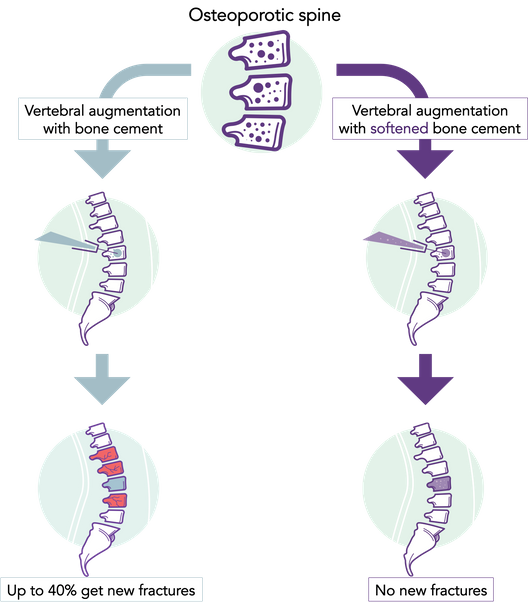
With the Inossia Cement Softener®, any bone cement will have a stiffness comparable to natural bone. The cement becomes elastic and restores height after compression (elastic recovery) while standard bone cement breaks.
Innovative technology for softening of bone cements
Using our softener for bone cements, we can adapt them to brittle osteoporotic bone. Less new fractures will occur and the patients will get a better treatment.
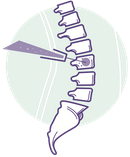
Today, osteoporotic fractures can be treated by injecting bone cement into the spine, providing pain relief and preventing the vertebrae from collapsing. Unfortunately, the bone cement used is too stiff for the brittle osteoporotic spine, giving rise to more fractures. This can be described as placing a stone into a pile of eggshells. Up to 40% of the patients come back with a new painful fractures.
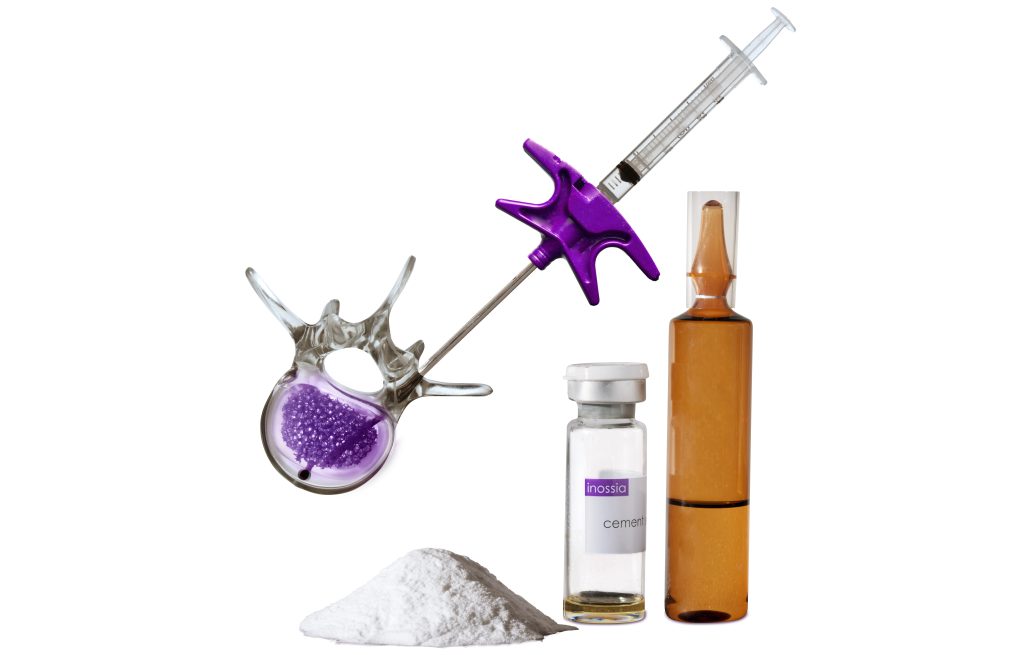
Based on research since 2013 and long-time feedback from physicians, Inossia® has invented a softener that can be used with any acrylic bone cements to modify their properties in order to make them less stiff and more suitable for osteoporotic bone. The softened cement becomes like a sponge instead of a stone in order to reduce the number of new fractures, thereby avoiding unnecessary, painful fractures.
Benefits of our softer cement
Less new fractures
Pain relief
Reduced healthcare costs
Active aging
V-FLEX - our groundbreaking soft cement for vertebral augmentation
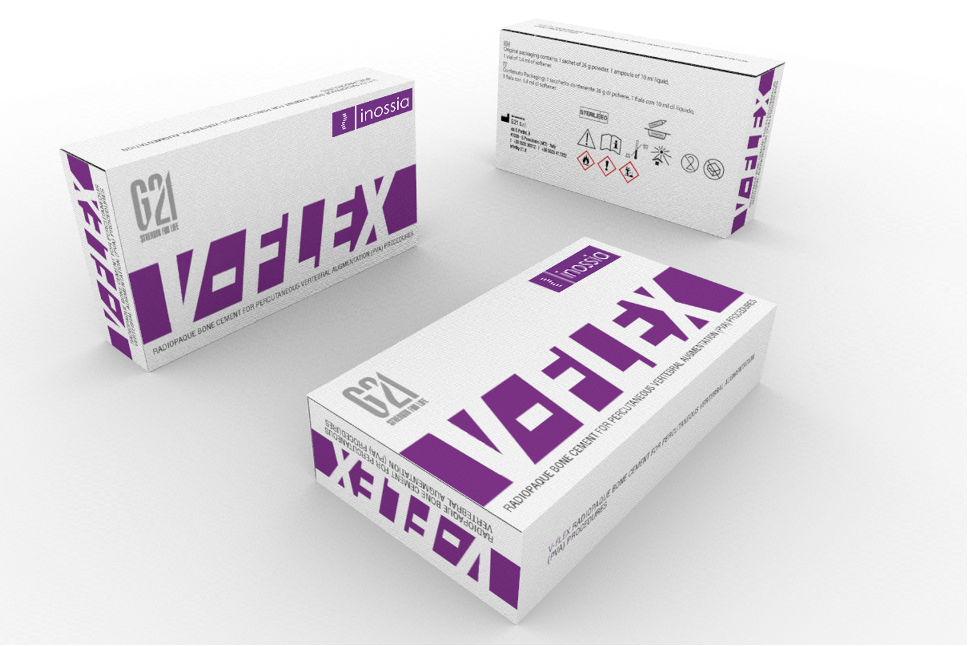
V-Flex is a bone cement for vertebral augmentation, which has been specially formulated to have mechanical properties adapted to bone, to reduce the risk of adjacent fractures. Its hardening temperature is 50% lower than that of the standard cements to reduce the risk of thermal damage, and it contains radiocontrast agent for optimal visibility and monitoring for percutaneous minimally invasive procedures. V-Flex is manufactured by G21 S.r.l. and is the first bone cement using Inossia’s cement softening technology to adapt it to osteoporotic bone.
CASE STUDY of V-flex
"Easy to prepare with early satisfactory pain control and functional recovery"
“The soft cement is a product that is easy to prepare, with waiting times for setting like other cements on the market, but with the sensation of less local heat to the touch. In our experience we have not seen relevant differences in the surgical technique or complications derived from its use, such as cement leakage. The evolution of the patients has been good, with early satisfactory pain control and functional recovery. ” Dr. Raquel Gutiérrez-González, Neurosurgeon, Puerta de Hierro University Hospital, Majadahonda (Madrid), Spain.
Dr. Raquel Gutiérrez-González
Neurosurgeon, Puerta de Hierro University Hospital, Majadahonda (Madrid), Spain
Get in touch with us
Want to know more about Inossia® or our cement softener technology. Get in touch with our team.